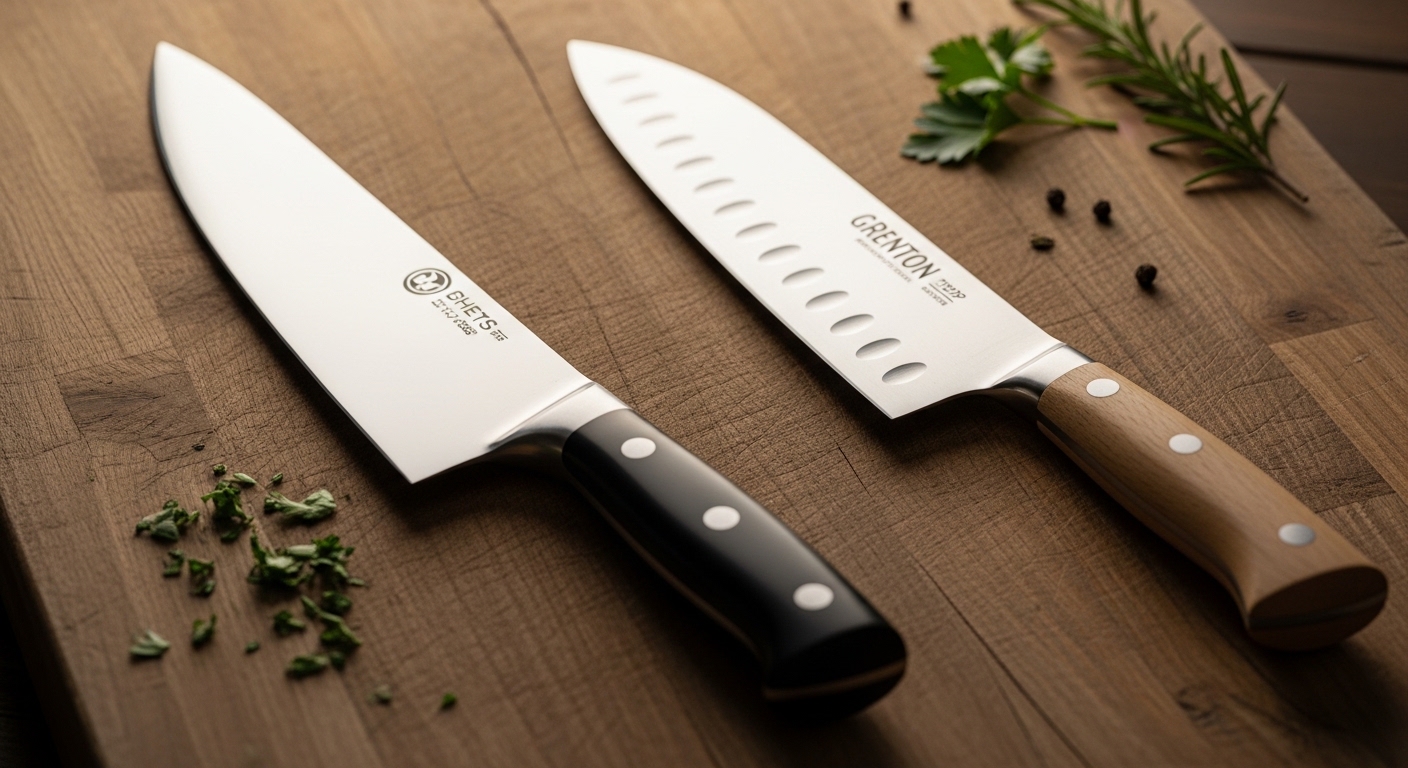
If you’re buying (or upgrading) one “do-most-things” kitchen knife, this is the classic debate. A chef’s knife is the traditional all-rounder with a curved belly for rocking cuts. A santoku is the Japanese-style everyday knife that feels fast and controlled for push-cutting and veggie prep.
Both can handle daily chopping and slicing—your best choice depends on how you naturally move your hands.
Quick overview: the real difference
Chef’s knife
- Longer blade (commonly around 8″)
- Curved edge (“belly”) designed for rocking motion
- Great for mixed tasks: veg, meat, herbs, longer slicing
Santoku
- Slightly shorter blade (commonly around 7″)
- Flatter edge designed for push cuts / up-down chopping
- Great for veg prep and clean, straight cuts
- Often has a taller blade height (good knuckle clearance)
Chef’s Knife: Pros & Cons
✅ Advantages
1) Most versatile for “everything”
It’s the best one-knife solution if you switch between:
- onions and herbs
- chicken and steak trimming
- long vegetables (eggplant, zucchini)
- slicing larger items
2) Rocking cuts feel natural
If you mince herbs or garlic with a rock-chop motion, the curved belly makes it smooth and fast.
3) Better for longer slicing
The extra blade length helps with:
- slicing roasts
- cutting melons
- breaking down cabbage
- clean slices through bigger ingredients
❌ Disadvantages
1) Can feel big in small hands
Some people feel less control, especially if they’re used to shorter blades.
2) Rocking can “accordion” veggies
With certain vegetables (like onions), rocking too aggressively can lead to uneven pieces if your technique isn’t consistent.
3) Less “tip control” for fine work (for some users)
Not worse—just different. Some people feel santoku gives more precise control for quick veg chopping.
Santoku: Pros & Cons
✅ Advantages
1) Excellent for everyday veg prep
Santoku shines when you do a lot of:
- chopping onions, peppers, carrots
- slicing cucumbers
- dicing potatoes
- prepping stir-fry ingredients
2) Push-cutting feels efficient
The flatter edge makes clean contact with the board—great for straight up-down chopping.
3) Often feels more nimble
The slightly shorter blade can feel safer and more controlled for many home cooks.
❌ Disadvantages
1) Less ideal for rocking cuts
You can rock a santoku, but it’s not as natural because the belly is flatter. Herb-mincing may feel slower.
2) Not as good for long slicing
If you cut big melons, large roasts, or want long single-stroke slices, the shorter blade can be limiting.
3) Tip work feels different
Some santokus have a less pointy tip than chef’s knives, which can reduce precision for tasks like trimming or scoring.
Head-to-head: which is better for everyday chopping & slicing?
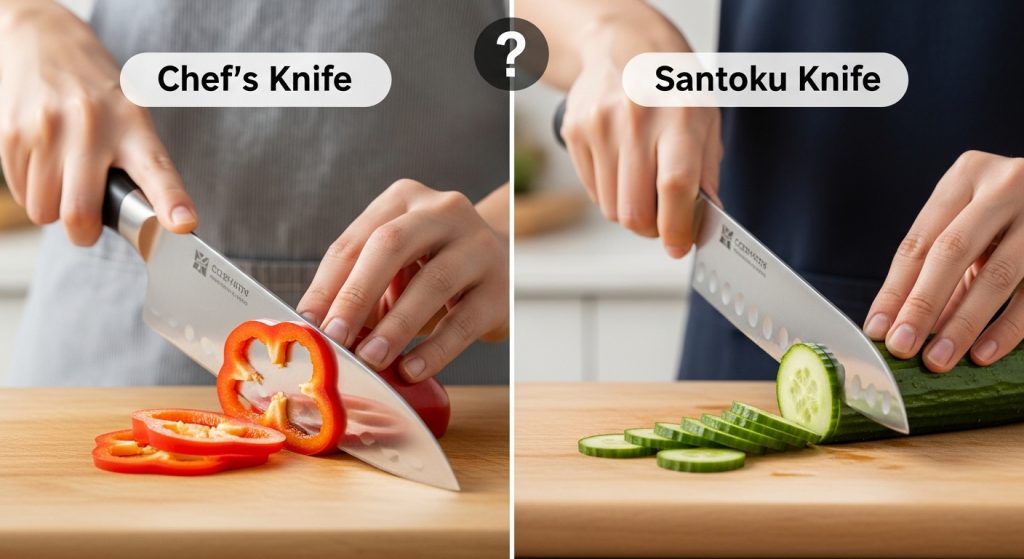
For chopping (onions, carrots, general veg)
- Santoku wins if you prefer straight up-down chops and want a controlled, fast veggie workflow.
- Chef’s knife wins if you mix chopping with a lot of rocking and varied tasks.
For slicing (tomatoes, chicken breast, cooked meat, fruit)
- Chef’s knife wins more often because length helps create cleaner slices with fewer strokes.
- Santoku is great for shorter slicing jobs, especially produce.
For mincing herbs and garlic
- Chef’s knife wins because rocking is easier and faster.
For small kitchens / small cutting boards
- Santoku wins because it’s easier to maneuver in tight space.
Which one is the optimal choice?
✅ Best overall “one knife for everything”: Chef’s Knife
If you want the knife that replaces the most and adapts to the widest range of tasks, chef’s knife is still the best default choice—especially if you mince herbs, slice larger foods, or cook a variety of dishes.
✅ Best for veg-focused cooking and fast prep: Santoku
If most of your daily cooking is vegetables, stir-fries, salads, meal prep bowls, and you prefer clean push-cuts, a santoku often feels more efficient and comfortable.
Easy decision checklist
Choose a chef’s knife if you:
- love rocking cuts for herbs/garlic
- slice large foods often
- want the most versatile “one knife” option
Choose a santoku if you:
- do mostly veggie prep
- prefer push-cutting / straight chopping
- want a slightly smaller, more nimble blade
Final verdict
For most home cooks who want a single daily driver, a chef’s knife is the better all-around choice because it handles more tasks and slicing jobs more comfortably.
But if your cooking is heavily veggie-based and you value speed + control on a cutting board, a santoku can be the better everyday tool—especially in smaller kitchens.