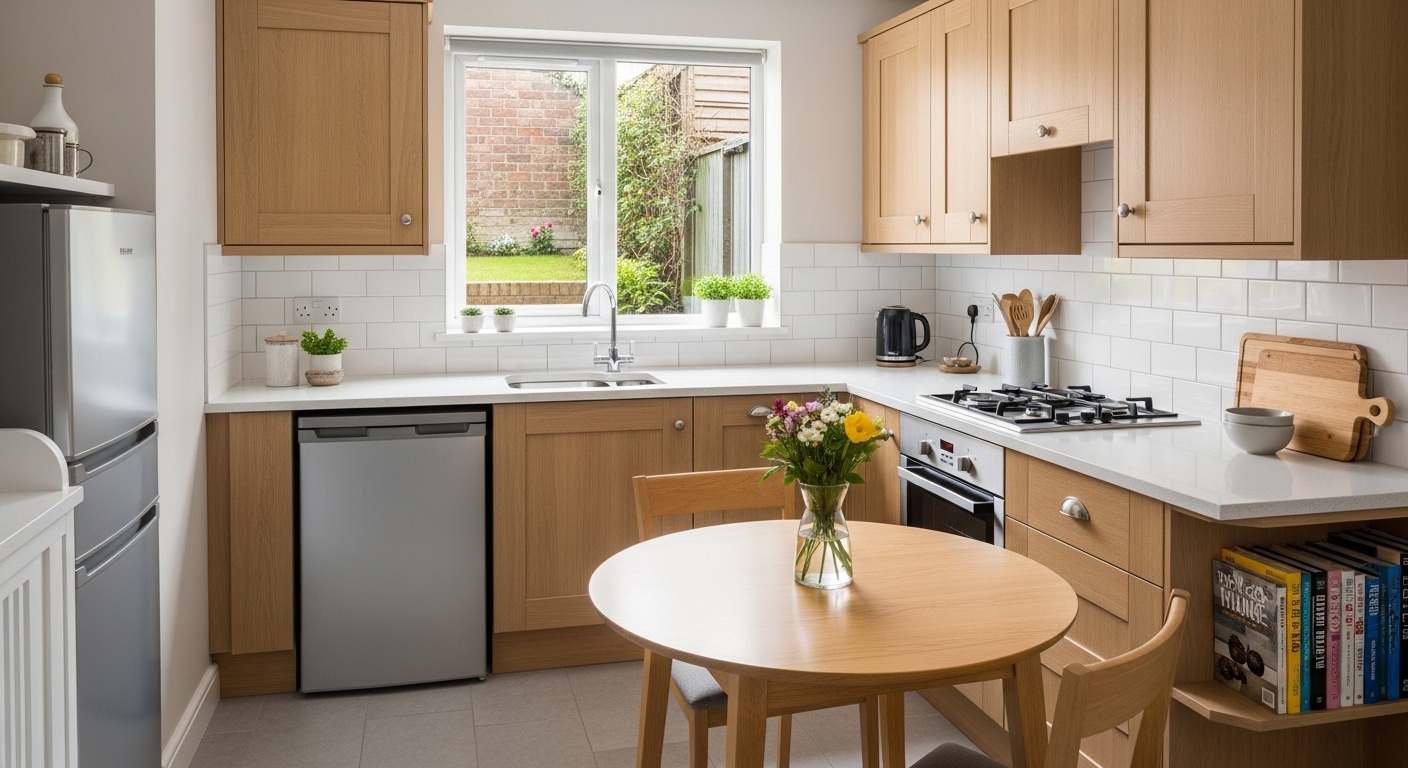
A small kitchen doesn’t stay tidy because you “try harder.” It stays tidy because everything has a logical home, the most-used items live where your hands naturally reach, and clutter can’t pile up in the first place. The goal isn’t a Pinterest kitchen—it’s a layout that works on busy weekdays and still looks clean after cooking.
Disclosure: Some links may be affiliate links. As an Amazon Associate I earn from qualifying purchases.
The mindset that makes small kitchens easy
Here’s the rule that changed my kitchen the most:
✅ Store items where you use them, not where you think they “should” go.
If you cook at the stove, your cooking tools should be near the stove. If you make coffee daily, that whole routine should live in one “coffee zone.”
Organizing is mostly about reducing steps.
Step 1: Do a 15-minute reset (before buying anything)
Before dividers or bins, do this:
- Clear one surface (counter or table)
- Pull everything out of one drawer + one cabinet
- Make 3 piles:
- Daily use (used 3–7 days/week)
- Weekly use (1–2 times/week)
- Rare use (monthly/seasonal)
This is the fastest way to see what’s stealing space.
Step 2: Set up “drawer zones” (the easiest way to stay organized)
Small kitchens win when drawers are task-based, not random.
Zone A: Everyday tools (the “grab without thinking” drawer)
Put near your main prep area:
- spatula, tongs, ladle
- peeler, can opener, kitchen shears
- measuring spoons/cups (if used often)
- small whisk
Rule: if you use it daily, it should be reachable with one hand.
Zone B: Prep + knives (if you have safe storage)
Near cutting board area:
- knives (in a tray/guard, not loose)
- bench scraper
- microplane/grater (if used often)
Zone C: Wrap + bag + foil zone
Near the counter where you pack leftovers:
- cling wrap, foil, parchment
- zip bags
- clips
Zone D: Junk drawer—yes, you’re allowed one (but with a boundary)
Limit it to one small drawer and add a divider.
If the junk spills into other drawers, the kitchen starts feeling messy.
Step 3: Cabinet rules that make everything feel bigger
Cabinets get chaotic when they hold “mixed purpose” items.
Rule 1: Keep heavy daily cookware in the easiest reach
- Lower cabinets near the stove: pots, pans, sheet pan, lid organizer
- Upper cabinets: lightweight plates, bowls, cups
Rule 2: Use “vertical storage” to stop the pile problem
This keeps things from becoming a messy stack:
- trays and cutting boards stored upright
- baking sheets upright
- pan lids upright
Rule 3: Don’t stack what you need daily
If you have to lift 3 things to get to 1 thing, you’ll stop putting stuff away properly.
Fix: pull daily items forward and push rare items to the back/top.
Rule 4: One shelf = one category
Example categories:
- breakfast items
- spices + oils
- baking supplies
- pantry snacks
When categories mix, your brain treats the cabinet like a “dump zone.”
Step 4: The layout that stays clean (3 core kitchen zones)
Think in zones rather than rooms.
Zone 1: Cooking zone (stove area)
Keep here:
- salt, pepper, oil
- cooking utensils
- pans/pots
- frequently used spices (small set)
Keep it tight: too many items around the stove = visual clutter.
Zone 2: Prep zone (cutting + mixing area)
Keep here:
- cutting boards
- knives
- mixing bowls
- colander
- food prep tools
This is the zone that saves the most time.
Zone 3: Clean-up zone (sink area)
Keep here:
- dish soap, sponge
- trash bags
- towels
- drying rack
- dishwasher pods (if you use them)
If your cleanup zone is messy, the whole kitchen looks messy.
Step 5: Counter rules (the secret to “always clean”)
A small kitchen feels clean when counters feel empty.
The “two-appliance rule”
Only keep two appliances permanently on the counter:
- the ones you use daily (coffee maker, kettle, toaster, etc.)
Everything else goes into a cabinet or pantry shelf.
Keep one “landing pad”
Create one small space where things can temporarily land:
- keys
- groceries
If you don’t create a landing pad, clutter lands everywhere.
Step 6: Simple organizers that actually help (without over-buying)
You don’t need a shopping spree. These are the few that truly help:
- Drawer dividers for utensil chaos
- Under-sink bins (one for cleaning supplies, one for trash bags)
- Vertical rack for lids and trays
- Lazy Susan for oils/sauces in deep cabinets
- Clear bins in pantry cabinets (group snacks, baking, etc.)
Buy only after you’ve built the zones—otherwise you organize clutter.
Step 7: A maintenance routine that takes 2 minutes
This is what keeps it clean long-term:
Night reset (2 minutes)
- clear sink
- wipe counter
- put 5 items away (even if you do nothing else)
Weekly reset (10 minutes)
- toss expired food
- wipe one shelf
- regroup anything that drifted out of its zone
Common small-kitchen problems (and quick fixes)
- Too many mugs → keep 4–6 accessible, store the rest
- Lid chaos → store lids vertically or in a rack
- Random appliances everywhere → keep only daily-use items out
- Overflowing spices → choose “daily spices” + “backup box”
- No space for prep → clear one prep zone, defend it aggressively
Final takeaway
A small kitchen stays clean when:
- drawers are built around tasks (zones)
- cabinets have simple category rules
- your kitchen runs in 3 zones (cook / prep / clean)
- counters follow the two-appliance rule
- you do a 2-minute reset
If you tell me your kitchen setup (galley, L-shape, studio kitchenette) and what you cook most, I can suggest the best zone layout and exactly what should go in each drawer/cabinet.